New environmental regulations for companies: what changes for your water management?
For companies with an IPCC installation, water management is becoming a more explicit part of their environmental obligations. The revised Industrial Emissions Directive requires more attention to pollutants at the source, to efficient water use, and to emissions.
Flanders approved the transposition on 1 October 2026; the new rules largely come into effect on 3 November. What exactly is changing for companies, and when must your installations comply with the new conditions?
Water Management and Pollutants in the Environmental Management System
An environmental management system (EMS) makes environmental care a standard business practice. Companies set targets and indicators, implement measures, and evaluate the results.
What must be included at a minimum?
- Waste prevention
- Raw materials and circularity
- Water management including reuse
- Energy
- Soil
- External safety
- Climate impact
The environmental management system also includes the follow-up of advice from the environmental coordinator and results from energy audits.
Flanders is replacing the statutory environmental audit with this systematic approach. A distinction is made between M1 and M2 companies; you can find in the table below what this classification entails.
| M1 companies | M2 companies | |
| Target audience | Industrial 1IPPC installations¹ and facilities with a combustion plant with a capacity of between 20 and 50 MW (currently the large asphalt plants and six other companies), as these also fall within the scope of the European Regulation on Industrial Emissions Reporting (IEPR) | Other Class 1 establishments required to appoint an environmental co-ordinator |
| Scope | Around 750 IPPC installations, 11 asphalt mixing plants and 6 other businesses | Approximately 5,650 businesses, based on an extrapolation |
| Deadline for MBS Is there an MBS? |
No later than 1 July 2027 | No later than 1 July 2028 |
| External audit Does the MBS comply with the law? |
At least every three years; the first audit must take place by 1 July 2027 at the latest | No external audit is required |
| Annual appraisal What results have been achieved, and where do adjustments need to be made? |
Initial assessment by 2028 at the latest | Initial assessment by 2029 at the latest |
| Additional GPBV requirements |
For IPPC installations: substance inventory, risk assessment and analysis of alternatives; transformation plan where required | These GPBV requirements are not generally extended to M2. |
1IPPC installations are industrial installations that fall under the integrated permitting framework of the Industrial Emissions Directive (IED).
Agricultural companies are not included in this. A separate European system is being developed for this (UCOL - uniform conditions for operating rules in the livestock sector).
It is important to note that pollutants are given a place in the EMS of IPPC installations. The EMS includes at least:
- An inventory of polluting chemical substances present in or emitted from the installation.
- A risk assessment of the impacts of those substances on human health and the environment.
- An analysis of the possibilities to replace them with safe alternatives or reduce their use or emissions.
For source protection, this provides a concrete basis to identify concerning substances earlier and limit emissions at the source.
What are the changes to emission limits and water use standards?
The revised rules also distinguish emission levels based on best available techniques (BAT-AELs) from BAT-associated environmental performance levels (BAT-AEPLs).
| Emissions of pollutants | Consumption and other environmental performance indicators | |
| Example | Zinc concentration in waste water, in mg/l | Water consumption in m³ per tonne of product; water reuse rate |
| BAT reference | BAT emission levels (BAT-GEN) from the European BAT conclusions applicable to the installation, expressed as a range | BAT environmental performance levels from European BAT conclusions applicable to the installation, expressed as a range |
| Adoption of a standard | The focus is initially on the lower limit of the bandwidth; the operator itself assesses the feasibility of the most stringent end of the range | Upper limit as a binding maximum |
Example pollutant
Suppose the bandwidth for a pollutant is 1 to 5 mg per litre based on the European BAT conclusions. Then the company must investigate whether the lower limit of 1 mg is achievable. A higher standard within the bandwidth requires justification. Based on a feasibility study, a standard of 3 mg/l is imposed in the permit.
Example usage
Assuming that the bandwidth for water consumption per ton of product is 2 to 6 m³, then 6 m³/ton is included in the permit.
When must an IPCC installation comply with new requirements?
Following the publication of new or updated BAT conclusions for the main activity, an IPCC installation must comply within four years with the new environmental conditions, for both emission limit values and environmental performance conditions. Additionally, the legislation provides specific arrangements with terms of six or a maximum of eight years for innovation, substantial industrial innovation, or closure and replacement (see below).
The timeline below provides an example of timing in the situation where new BAT conclusions were published on 1 October 2028.
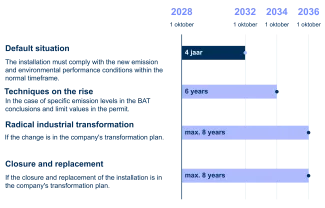
The compliance period begins with the publication of the BAT conclusions for the main activity, not with the permit adjustment. For example, if the conclusions are published on 1 October 2028 and the permit is adjusted in 2030, the installation must comply with the applicable new conditions by 1 October 2032 at the latest in the usual situation.
Example of emerging technology
The European BAT conclusions for a proven water purification technique may include an emission range of 5–15 mg/l, and for an emerging technique, a separate range of 2–8 mg/l. Based on feasibility, a limit value of 6 mg/l, for instance, can be established, which the company is given 6 years to achieve.
Temporary Deviations Possible for Innovation or Crisis Management
For the testing of emerging technologies, a temporary ministerial deviation from certain emission and performance conditions may be permitted for a maximum of 30 months. The technology does not need to be included in the BAT conclusions yet but must promise better environmental protection or at least equivalent protection at lower costs. Flanders also opens this test arrangement for installations outside the IPCC group.
In an exceptional crisis, it may temporarily be allowed to apply less stringent emission or environmental performance limits. This can occur during serious disruptions or shortages beyond the control of the operator and the government, when the public interest justifies the deviation. All possibilities to limit pollution must be exhausted, and no significant pollution may occur. The deviation lasts for a maximum of three months, with the possibility of an additional three-month extension. It ends earlier as soon as normal conditions are restored or an alternative is available.
Preparation Begins with Understanding Substances and Emission Routes
The revised EIA demands timely preparation, especially to gain insight into pollutants and their emission routes. Product lists and safety data sheets are a starting point but do not always suffice to determine risks and effective measures. The mandatory listing of components depends on their hazard classification and concentration.
At the same time, the policy framework is evolving. The European environmental omnibus package, proposing revisions to the EIA, challenges, among other things, the obligations surrounding transformation plans, independent audits, and the substance inventory. The Flemish approach to substances of concern also deserves follow-up.
VITO Kennispunt Water aims to support and relieve companies with the new regulations by clearly explaining policy developments and bundling knowledge and practical experiences. Together with companies, sector organisations, and governments, we also want to explore which methodologies and support are needed and which best practices can be widely applied.
Why was the Industrial Emissions Directive revised?
The original Industrial Emissions Directive (IED) helped reduce industrial pollutant emissions, particularly into the air. With Directive (EU) 2024/1785, Europe broadens its approach: fewer harmful emissions, more efficient use of water, energy, and resources, less waste, and more room for innovation.