
Opinion: Heat calls not just for cooling, but a cooling strategy
The drought level has just been raised to code orange. It is becoming apparent how quickly heat and water scarcity together are putting pressure on water, electricity, and infrastructure. According to VITO Kennispunt Water, Flanders is at risk of developing a new vulnerability if cooling is only addressed with more air conditioners and additional cooling capacity. Dirk Halet therefore advocates for a cooling demand ladder: first avoid cooling demand, then cool more efficiently, utilise residual heat, share heat and cold, and only then build extra cooling capacity.
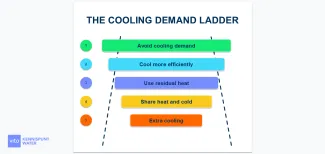
You don't solve heat by adding extra cooling everywhere. We need to design heat, cooling, water, and space together.
The reflex to heat is understandable: more cooling. But if that solution simultaneously requires more electricity, discharges more heat externally, and increases the pressure on water, we are merely shifting the problem. Flanders therefore needs not just more cooling capacity, but above all a cooling strategy.
The recent heatwave made this vulnerability tangible: Flemish hospitals had to postpone care due to an overheated server in Paris, French nuclear reactors were temporarily limited because the cooling water became too warm, and Sciensano reported 1,747 additional deaths during the heatwave at the end of June.
Thus, a clear vulnerability arises. Just when society needs more electricity for cooling, some power plants can produce less due to restrictions on cooling water, and the electricity grid can also come under pressure from simultaneous peak demand. At the same time, a vicious circle looms: an air conditioner cools the interior but expels the absorbed heat outside. In densely built cities, this residual heat can accumulate and intensify the urban heat island effect.
Heat is a stress testfor our society. It tests whether homes, schools, hospitals, power plants, data centers, and public spaces can withstand temperatures for which they were not designed. The real resilience test occurs when heat coincides with drought. Then the demand for cooling increases while water is not guaranteed.
That’s why we need to look at cooling differently. Not as a technical afterthought added when buildings, neighborhoods, or processes are already designed. Cooling should be at the start of design, together with heat, space, energy, and water.
Europe acknowledges this challenge and mentions initiatives around dry cooling. This is appropriate, but dry cooling is not a panacea. The technique saves water but requires more energy and space, makes more noise, is more expensive, and is less efficient at high outdoor temperatures. The big gain does not come from one technical breakthrough but from smart combinations within a water strategy.
This is precisely where the role of water expertise lies : not only saving water but also determining what cooling demand we actually create.
A water strategy that only looks at drinking water, drought, abstraction bans, and reuse misses an increasingly important piece of the puzzle: the growing demand for cooling. Therefore, we need a cooling demand ladder, analogous to the Water Efficiency First principle. The order matters: first avoid cooling demand, then cool more efficiently, use residual heat, share heat and cold, and only as a last step build extra cooling capacity.
That ladder starts with less cooling demand. Shading, green roofs, de-sealing, and smart building orientation are not soft edge measures. They determine how much active cooling will later be required. Every degree avoided does not need to be offset with electricity, cooling water, or additional infrastructure.
Nature deserves a more central place in this. Trees cool through shade and evaporation from their leaves. Here too, without a water strategy, there is no cooling strategy. A tree in a hardened, dry street will only use a part of its cooling potential. A livable city above ground starts underground, with soil, root space, and water availability.
Sometimes, the best cooling measure does not stem from the cooling technology itself. More energy-efficient chips, more efficient data centers, and smarter software use reduce heat production at the source. This too is cooling policy: producing less heat so less heat needs to be dissipated.
For companies, cooling affects much more than comfort: it relates to production continuity, permits, cooling water availability, thermal discharges, energy costs, and investment decisions. Cooling water is gaining importance again in Flanders, particularly in energy and chemistry.
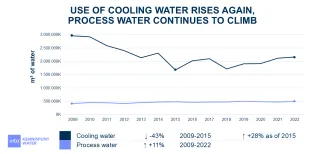
Industrial water security thus depends not only on purification or reuse but also on the way companies cool, dissipate heat, utilize residual heat, and share infrastructure. This economic dimension especially reinforces the broader message: cooling is not an isolated technical issue but part of a water and energy system.
Next comes the spatial question. Why let each building, neighborhood, or company invest individually in cooling and heat dissipation when you can look at shared infrastructure? Cooling can be designed as collective infrastructure rather than a sum of air conditioners.
This is precisely where Flanders can show strength: by not solving each problem separately, but making linkage opportunities visible. Between water and energy. Between companies and neighborhoods. Between heat surplus and heat demand. Between urban cooling, industrial processes, and water availability.
The demand for cooling will increase. The choice is whether to let that demand grow uncoordinated, with more individual air conditioners, more peak consumption, and more pressure on water and energy. Or to design cooling henceforth as part of a water strategy.
This requires different conversations, earlier in the process: between water managers, energy companies, urban planners, businesses, healthcare institutions, and technology partners. Anyone thinking about cooling only when the heat is already present is too late. Cooling must be at the start of every design, together with water, energy, space, and heat.
Sources
- Sciensano: figures on excess mortality during the heatwave at the end of June 2026.
- VITO Kennispunt Water: a study on the economic importance of water in Flanders, including figures on cooling water usage.
- Europese Commissie: Water Resilience Strategy and initiatives relating to dry cooling.
About VITO Kennispunt Water
VITO Kennispunt Water strengthens the water transition in Flanders by connecting data, research, and innovation with policymakers, businesses, agriculture, and local authorities. The knowledge centre develops insights and solutions that contribute to water security and sustainable economic growth.