From Pilot to Practice: VITO Opens Test Site for Treatment Wetlands in Assenede
Can treatment wetlands upgrade surface water to a usable water source? In Assenede, VITO is investigating this in a modular laboratory with six different treatment wetlands. The new research infrastructure not only serves Aquatuur, but also offers opportunities for collaboration with (drinking water) companies, water managers, governments, and knowledge partners.
Plenty of Water, but Not Always of the Right Quality
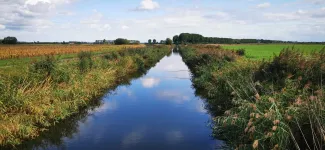
In various locations in Flanders, including the Isabellepolder in Assenede, excess surface water is discharged annually. However, this water could be utilized locally for drinking water production, agriculture, or industrial applications, or temporarily stored underground for later use. Unfortunately, water quality often poses a challenge, as surface water does not always meet the requirements for use as process water, underground storage, or other applications.
Within the Interreg Vlaanderen-Nederland project Aquatuur VITO, HZ University of Applied Sciences, and Ghent University are investigating how treatment wetlands (‘artificial’ purification reed beds) can improve surface water quality. The central aim? To determine which type of wetland is most suitable for a specific water flow, pollutant, and/or application.
This is where the unique and essential nature of this research lies. Surface water is a distinctive resource: contaminants often occur in low concentrations while the volumes to be treated can be large. Hence, a standard solution is not sufficient. The optimal configuration of a treatment wetland strongly depends on the type of source water, the substances present, and the desired application. Practical tests are therefore necessary to arrive at an effective and scalable design for each situation.
Six wetlands, one flexible research environment
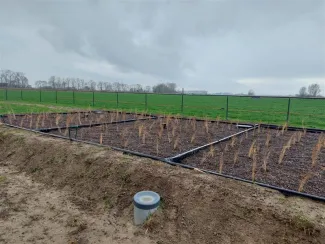
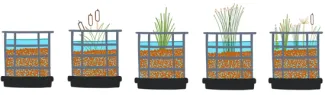
We are pleased to introduce our demonstration site in Assenede, which consists of six modular wetlands built according to different principles: floating wetlands, horizontal subsurface flow wetlands, and free water surface wetlands. Some systems are actively aerated. Additionally, we test various types of substrate, including biochar.
Thanks to this modular setup, we can compare how well the different systems remove various contaminants under realistic conditions. These include pesticides, PFAS, heavy metals, polycyclic aromatic hydrocarbons, nutrients, and microplastics.
By testing the setups side by side and in combination, we gain a better understanding of which combination of wetland type, substrate, aeration, and process control delivers the best results. This way, we build the necessary practical knowledge to transition from a promising pilot to a robust application on a larger scale.
The test site is therefore more than just a research setup. It serves as a place where nature-based and traditional water purification can strengthen each other, where new concepts can be tested and validated, and where researchers and end-users can learn together.
Submit your water-related query
Do you have a surface water source that does not yet meet the requirements for your application? Would you like to test a new substrate, monitoring method, or setup in practice? Or are you researching how a treatment wetland can be integrated into an existing water purification system? Do you want to test how the combination between grey and green can be made?
We are happy to see how your issue can align with the possibilities of the demonstration site. Feel free to let us know!
Discover the Testing Ground on 10 September
Curious about how treatment wetlands work in practice ? On 10 September 2026, Aquatuur is organising an interactive afternoon 'From Pilot to Full Scale: Improved Surface Water Quality with Treatment Wetlands'.
We will share the initial experiences and lessons from the pilots. Then, Flemish and Dutch end-users, experts, policymakers, and practical partners will jointly explore the non-technical barriers that still hinder the broader application of treatment wetlands. The afternoon will conclude with a visit to the demonstration site in Assenede.
The workshop is primarily aimed at organisations that want to utilise surface water but encounter inadequate water quality for their application. During registration, you can choose the workshop, the site visit, or both. Everyone is welcome, and participation is free, but registration is mandatory.
Practical Information
-
10 September 2026
-
From 12:45 to 17:00
-
In Terneuzen and Assenede
-
Free
-
In Dutch
Aquatuur is a project within the Interreg Flanders-Netherlands programme. In the Scheldt Mouth region, the project partners demonstrate nature-based green-blue solutions that contribute to better water quality, greater water availability, and a more climate-robust water system.