Speye basin in Kortemark ready: 84,000 m³ water buffer for agriculture and industry
Water that used to flow away unused via the Speyebeek now gets a second life. At the end of September, five farmers, vegetable processor Verduyn, and Wienerberger in Kortemark began using a water buffer of 84,000 m³ that locally stores quarry water for reuse in agriculture and industry. The Speyebekken thus creates a new water reserve for the region and helps farmers and businesses better prepare against drought.
From Water Loss to Water Reserve
The Speye Basin originated from a remarkable observation. While vegetable processor Verduyn constantly needs water for washing and processing vegetables, Wienerberger annually pumps up to 100,000 m³ of quarry water during clay extraction. Until now, that water was discharged into the Speyebeek.
"It was painful to see perfectly usable water flowing away to the sea, where it is lost without being used, especially when there is a significant water scarcity during hot summer months. This project idea stemmed from that observation, and thanks to this collaboration, we can utilize the water locally and make our production more sustainable,” Daniël Verduyn, founder of Group Verduyn.
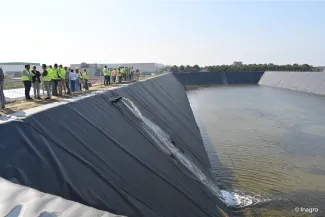
What started as a conversation between the two companies grew, with support from Inagro and VITO Knowledge Centre Water, into a concrete project. On a Wienerberger site, there is now a water buffer of 84,000 m³, equivalent to about four football fields. The basin will store water during wet periods and can then be used for agriculture and industry.
Investing Together in Greater Water Security
The project includes not just the water basin but also a pump house and a pipeline network that distributes the water to various users. For the farmers, a low-pressure pipeline network of approximately four kilometres is being constructed.
The construction of the basin, the pump house, and the pipeline network represents an investment of about 1 million euros. The project is supported by the Flemish Blue Deal, the Province of West Flanders, and LEADER Westhoek, but it also requires a significant investment from the partners involved.
The need for such alternative water sources is growing. In West Flanders, farmers have faced capture bans on non-navigable waterways eight times in the past decade, precisely at times when the water demand in agriculture is highest. For the farmers involved, the Speye Basin represents much more than an additional water buffer.
"For us as farmers, the Speye Basin means we can rely on sufficient water even in dry summers. It provides peace and security for our crops, improves quality, and increases the likelihood of a good harvest,” Klaas Soenen, farmer.
Additionally, the project also offers practical benefits. Thanks to the pipeline network, water is available closer to the fields, reducing the farmers' dependence on time-consuming transport with water tanks. This saves time, costs, and traffic movements.
Win-Win for Agriculture and Industry
For Verduyn, the project offers an additional and sustainable water source. The company can reduce its dependence on piped water while building in extra assurance for future growth.
For Wienerberger, the quarry water that was previously discharged to the Speyebeek now has a useful purpose. At the same time, the company now also has an additional water buffer for the future.
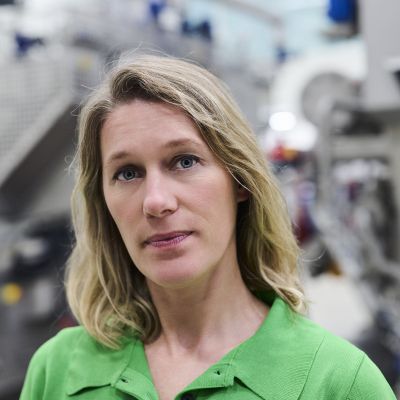
"For us, this project is a logical step in our sustainability thinking. We are using a water stream that is already present, but previously had no value. By collaborating with other partners, the water meets multiple needs and increases the efficiency of the entire water system,” Caroline Van de Velde, CEO at Wienerberger.
The benefits extend beyond the partners involved. Thanks to the continuous supply of quarry water, approximately 160,000 m³ of water will be sustainably used annually, while the basin itself has a storage capacity of 84,000 m³. This reduces the pressure on high-quality piped water and groundwater and makes more surface water available in the region.
An Example for the Future
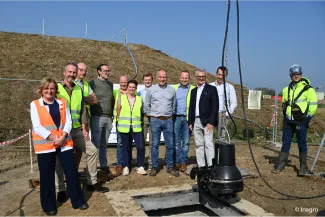
According to Deputy Bart Naeyaert, the Speyebekken demonstrates how companies, farmers, and governments can collaboratively develop solutions for the water challenges of tomorrow.
“Projects like Speyebekken show that collaboration pays off. By retaining water locally and reusing it smartly, we strengthen both our resilience to drought and our long-term water security. Thanks to everyone who contributed, thought along, and financed this."
A Typical Role for VITO Kennispunt Water
Together with VITO Kennispunt Water, Inagro guided the project from the initial explorations to its realization. Both organizations supported the partners in concept development, financing, and project coordination. Water innovator Charlotte Boeckaert confirms the replicability of such initiatives: “We need to change our mindset and retain excess water during the winter instead of discharging it. Water basins can be constructed throughout Flanders to protect us from both drought and flooding.”
The management of such water infrastructure requires clear agreements. VITO Kennispunt Water offers guidance in establishing these agreements. This includes the correct distribution of water, fair pricing to cover operational costs, obtaining insurance, notarizing easements, … The list is not exhaustive, but the message is clear: good agreements make good friends.
Additionally, significant financial resources are required to fund this water infrastructure. Fortunately, subsidies provide relief and can thus reduce financial risk. This is important to persuade a lender. In general, water resilience is higher on the agenda, as reflected by the public and private funds being allocated (or at least, that is our hope).
It's a forest with many trees, and the challenge is to find the right instrument for the right application.
Challenge accepted!