Systemic Icebergs in the Polders and the Dangers of Linear Thinking.
We previously discussed the complexity of the polder system and how this system has historically developed and been systematically expanded with only one function: the drainage of water. Thus, we discharge the precipitation that falls in the East and West Flemish polders along the Dutch border via the Leopold Canal. From the land, to the groundwater, to the capillaries, through the waterways to that long straight channel and linea recta to the sea.
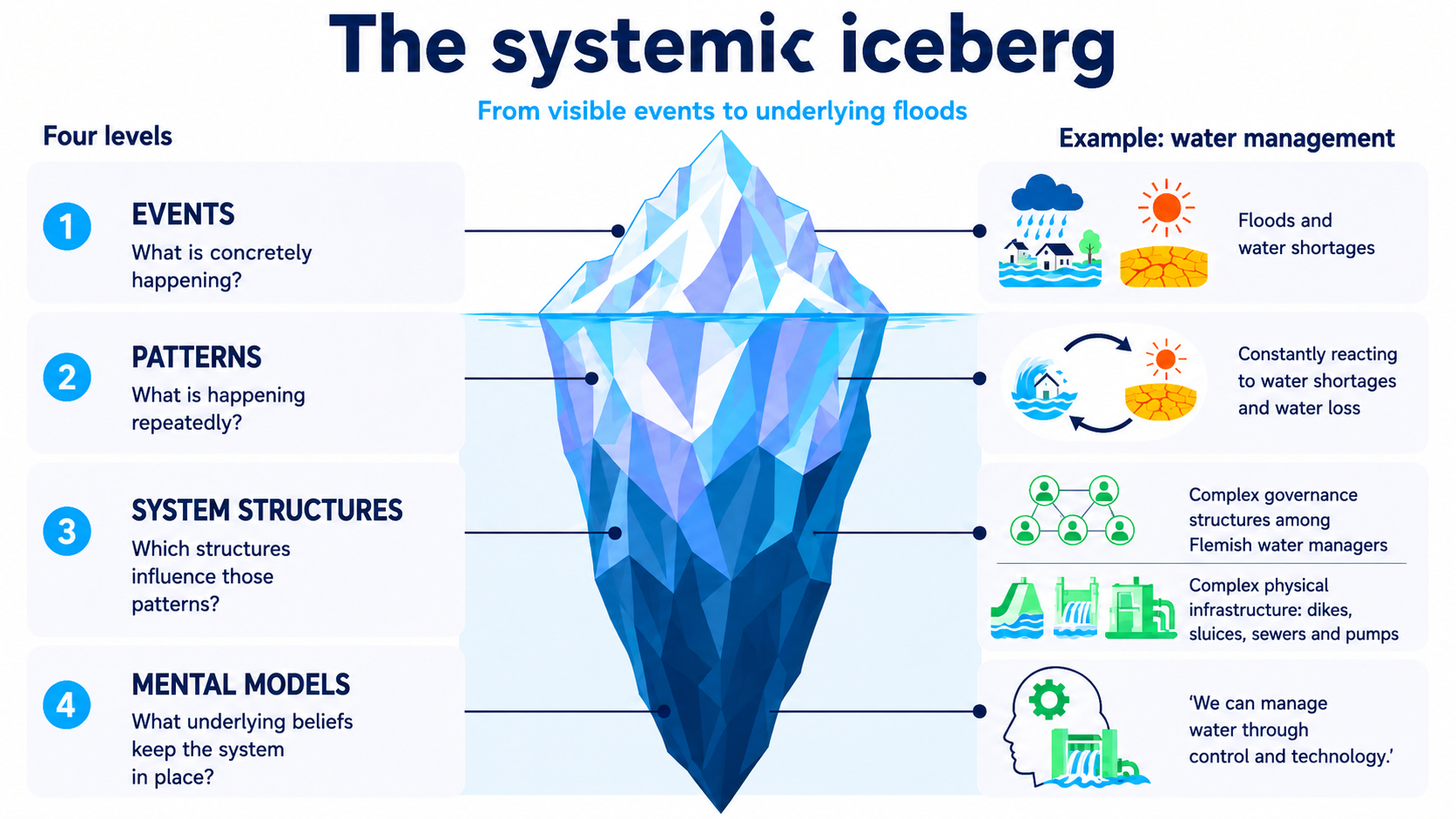
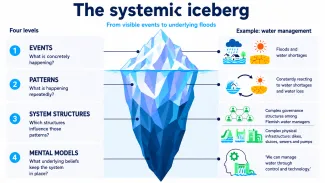
In systems thinking, we speak of systemic icebergs. If you properly descend such an iceberg with the right questions, it reveals the thinking behind systems. There are the events we experience and see, but these are the result of underlying patterns (sometimes visible, sometimes not) which in turn are a result of the underlying system, and that system itself stems from a specific way of thinking or mental model. When we apply all this to the classic polder system, which is based on a fairly linear way of thinking, it looks a bit like this:
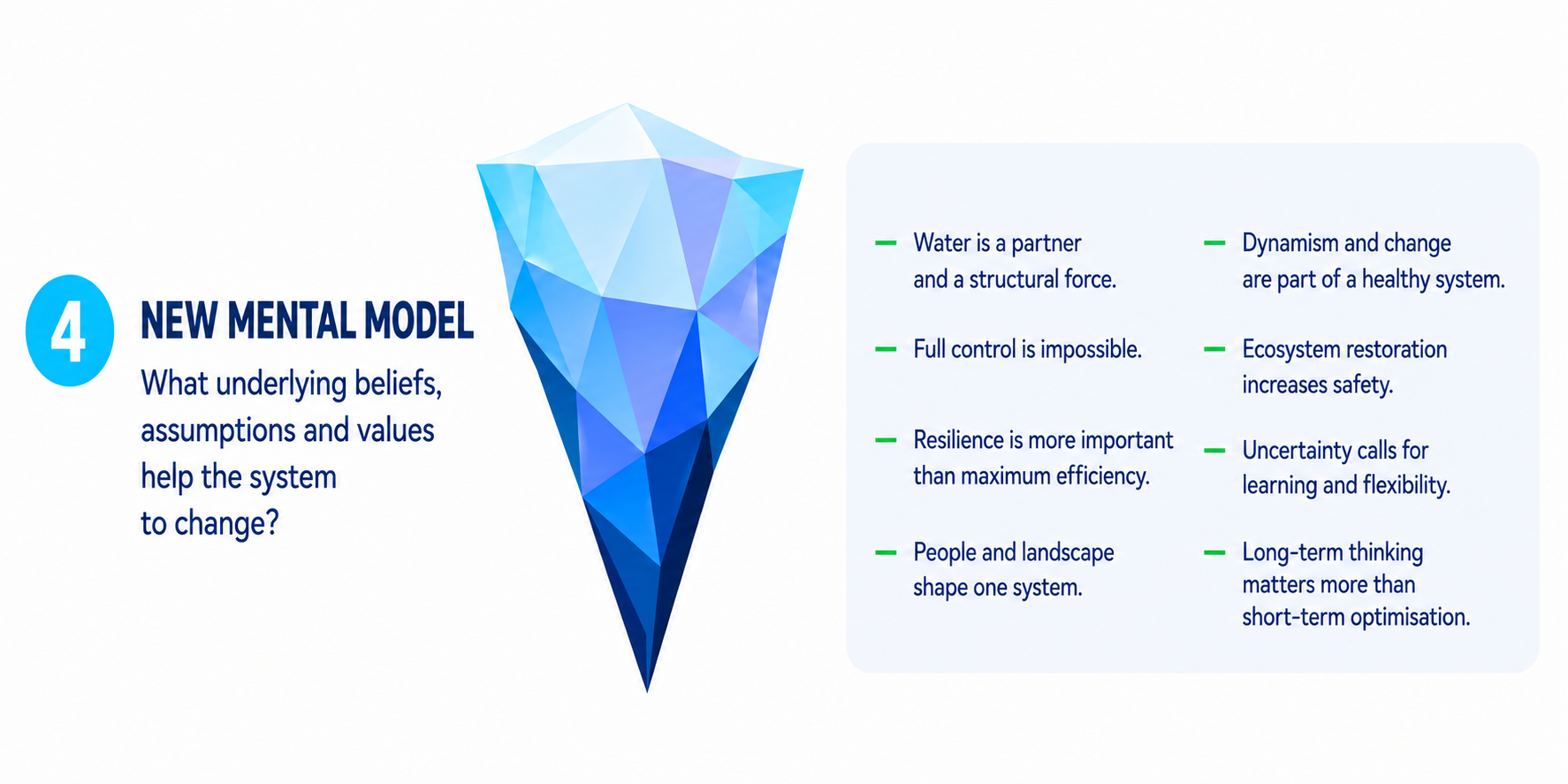
But the changing climate demands a different mental model. We must transition, even though that may sound rather forceful. However, there are quite a few additional benefits to be found if you manage to view the system broadly.
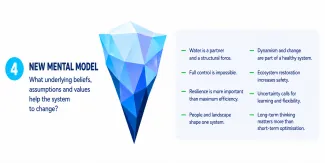
We can no longer tackle the current challenges purely mechanistically and obsessively try to control everything. We neither have the resources for it, nor the energy, and continuing with that mental model traps us (in a so-called lock-in). The classical system was brilliant for the challenges of a time with a stable climate and the challenges of that era, but today's climate and landscape require further evolution.
Through a different mental model, we learn to cope with this change and work in harmony with nature as a society, instead of wasting so much energy and becoming frustrated trying to control that nature. We must learn to act and be effortlessly (or wu-wei). No worries, the polders still need infrastructure, protection, and management, but the role of management and technology shifts from dominating that system to supporting ecological processes and adapting ourselves.
Climate models, water balance models: models, but not predictions
The main reason for this is that we simply do not know exactly what is going to happen. The climate models give us an initial idea: winters on average will become wetter, with more intense precipitation peaks and a greater risk of flooding. Summers, on the other hand, will become drier, with longer periods without rain and increased evaporation due to rising temperatures. As a result, the risk of both extreme drought and heavy rainfall in a short period of time increases, leading to greater fluctuations in water availability. However, these are just the broad outlines, and much uncertainty remains. We must learn to ‘dance’ with this reality rather than trying to remain stationary.
And these climate models are not the only models we are using in the WIJ-Water project. The water system in the polders is a real labyrinth, and it is nothing short of admirable that the many water managers are able to control this system. And that's just addressing the past and the present. Moreover, drought is a new factor in a system primarily designed for water drainage. How will all that water move in ground and surface water under these future conditions, and what does that mean for what we can do? If we want to understand how all this works so we can better prepare for changes due to drought and flooding, we must work with a water balance model to form an idea of the effects that certain interventions in the water system have.

A water balance model maps out the water flows within an area or system based on various data. It shows how water enters, is stored, used, and disappears again. This provides insight into water shortages, water surpluses, and the impact of different management measures.
A model is, of course, a simplification of reality to make the entire system more comprehensible. Not a crystal ball, but a tool to guide us and support decisions and make trade-offs. What measures can we implement to combat drought? What effects can investments in that water infrastructure yield, and how does the system respond to it, and where are those effects? What is the trade-off worth?
Moreover, we must not forget that such a model is a purely hydrological model with the region's water infrastructure, providing insight into the implementation of measures, but only the possibilities within that solution space of the water infrastructure. It primarily looks at bottlenecks to then consider solution strategies or bundles of measures, from the current situation and way of thinking.
Back to Schipdonk
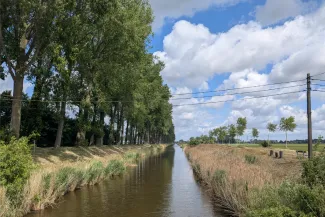
The recent years' prolonged droughts have been a concern for the water managers in the polders, but last year, temporarily raising the level of the Schipdonk Canal allowed for water to be brought into the polders using siphons. Large pipes were deployed to direct the available water to the drying waterways, alleviating the most urgent needs.
We have been taking similar actions in many places across Flanders since we have felt the impact of climate change more strongly. We are looking for solutions and trying to provide more water. In some areas, this is done by creating additional water reservoirs, while elsewhere water is diverted from temporary extra reservoirs. We react to events and we see patterns, as there is ongoing consideration to implement these actions in a more structured manner and invest in this approach.
But modelling alone is not a solution without systems thinking
At first glance , this seems like a good solution and common sense: get water where it is available. Otherwise, create a water supply. The water from the Schipdonk Canal is at that moment an available water source that can be easily utilised. There's nothing wrong with that and it's relatively cheap.
The question is whether we will take this ad hoc approach every summer or if we will develop an entire infrastructure to make this permanently feasible. That remains to be seen, as is a logical solution from linear thinking a good long-term solution. In a strong>previous article we already introduced a system archetype for problem-solving and how this led to the Schipdonk Canal itself. Are we possibly in the same situation by thinking this way?
Depending on the lens through which you look, you could see the same archetype at work here or one that closely resembles it. To keep it simple and to introduce a new archetype from the problem-solving arsenal, we can refer to the system archetype quick fixes (aka ‘Fixes that fail’ or ‘Fixes that backfire’).
To see this clearly, we need to zoom out and look at the bigger system of which the Schipdonk Canal is a part. And to do that, the insights gathered from many different stakeholders in the WIJ-Water workshops and during the wanders are important, as each perspective is an enrichment. In this case, there is indeed the question of whether the water from the Schipdonk Canal will always be available, according to a water expert who also follows the larger system upstream. Because upstream, too, there is an increasing demand for water, and salinization is increasingly affecting ports, which also would like to get more freshwater. If you are at the very end of the chain, is it a good solution to fully rely on that water and invest all your money in it? Or are we better off continuing to experiment and using that solution temporarily while we look at the various options with a system lens and also evaluate the effects of that siphoning?
Systems thinking teaches us that what intuitively seems the best solution from linear thinking does not necessarily yield robust and at the same time dynamic long-term solutions. This applies to adding lanes on congested highways, increasing the use of pesticides or antibiotics to maintain performance, overfishing by deploying larger fishing fleets, trying to prevent forest fires by also suppressing small fires, pumping more groundwater during droughts, etc. The remedies will only enlarge the problem in the long term.
Through a Transition Lens
If we continue to examine our case through the lens of a transition necessity that seemingly decreases, you can also discern another archetype in it: ‘Shifting the Burden’, also known as ‘Addicted to Symptom Treatment’ (aka Shifting the Burden). This occurs when you focus on a particular solution and consequently do not delve deeper into the systemic iceberg, thereby dedicating less attention and resources to the fundamental solution.
We are now working with the water balance model and , based on the results of the climate models, we are looking at which solutions exist at the level of the technical water system. Meanwhile, let us ensure that to address the challenges of an uncertain future, there are other possible paths. Paths that make it possible not to always act reactively, but to steer along with what that future will bring. And for that, we need to dive deep below the waterline.
To be continued anyway.